Smart Justice

The ACLU’s Campaign for Smart Justice has played a leading role in building an unprecedented nationwide movement to end mass incarceration.
Graphic featuring a gavel resting on the U.S. Constitution beside broken handcuffs and red barbed wire.

Nevada deserves a justice system rooted in fairness, not fear. For too long, mass incarceration has devastated families and drained public resources without actually making our communities any safer. When punishment replaces rehabilitation, everyone loses.

ACLU’s Smart Justice campaign works to reduce mass incarceration and transform the criminal legal system. We’re fighting to reduce prison populations, end cash bail, expand access to treatment, and ensure that second chances are real.

The Latest

News & Commentary
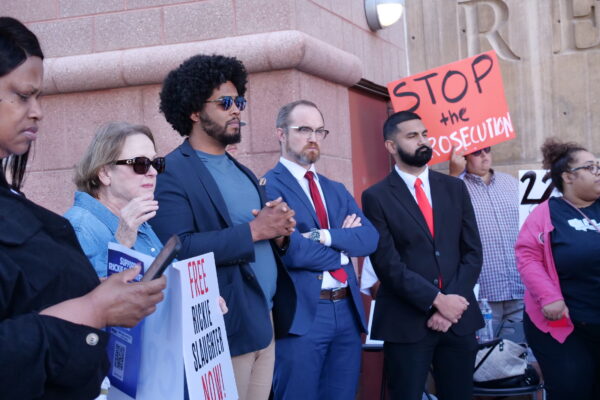
Advocates in front of the Eighth Judicial District Court rallying for the release of Rickie Slaughter.

Clark County DA called on to honor judge’s ruling vacating a prisoner’s conviction

Criminal reform advocates and civil rights groups, including the Mass Liberation Project, the ACLU of Nevada, and the NAACP Las Vegas, gathered Tuesday at the Regional Justice Center, demanding that Slaughter be set free. 
News & Commentary
Nevada State Senate building

Nevada state Senate passes crime bill after adding immigration-focused amendment

Tuesday brought a plot twist to the Nevada State Legislature and Gov. Joe Lombardo’s sweeping crime bill, with the introduction of an amendment adding provisions that would protect students from Immigration and Customs Enforcement and a brand new bill whose language mirrors two key components of the crime bill.
Press Release
Placeholder image

Civil Rights Advocates React to Senate Passage of Lombardo Crime Bill

Press Release
Placeholder image

Civil Rights Advocates React to Assembly Passage of Governor’s Crime Bill

Assembly terminates telephonic testimony for public but remote votes allowed for vacationing legislators
Issue Areas: Smart Justice
Court Case
Apr 27, 2026

Filutowski v. Las Vegas Metropolitan Police Department (Amicus)

Sebastian Filutowski sold his Camaro in a legitimate transaction and received payment in cryptocurrency, which he converted to U.S. dollars. LVMPD later froze and seized more than $50,000 from his bank account through its Cyber Investigative Group policy. Under that policy, detectives can seek a warrant without notifying the property owner, classify the person as a “secondary victim,” and transfer the money to another person without filing a forfeiture case or providing an adversarial hearing. Filutowski filed a lawsuit seeking the return of his property and an order blocking law enforcement from using property seizure practices that deny people due process. The district court ordered LVMPD to return his money but denied his request for a permanent injunction. Filutowski appealed that decision to the Nevada Supreme Court. We filed an amicus brief, in partnership with Nevada Attorneys for Criminal Justice, because law enforcement should not be allowed to bypass due process through internal policies that function like civil forfeiture while avoiding forfeiture safeguards. In our brief, we argue that LVMPD’s Cyber Investigative Group policy has the same real-world impact as civil forfeiture: a person loses access to their property and must fight the government to recover it. We also argue that the harm occurs when the property is taken, not only after someone has exhausted every possible legal remedy. Returning money months later does not erase the violation or the cost of being forced to litigate for basic constitutional protections.
Court Case
Apr 22, 2026

Nevada Department of Public Safety v. Lara (Amicus)

In 2021, Nevada Highway Patrol (NHP) stopped Lara while he was driving through Nevada to visit his daughters in California. During the stop, officers seized over $85,000 in cash, which was his life savings. Lara was not arrested, charged with a crime, or issued a ticket. Instead of following Nevada’s civil forfeiture process, NHP routed the money through the federal adoption and equitable sharing program. Through that program, state and local law enforcement agencies can transfer seized property to the federal government and later receive a portion of the proceeds. Under civil forfeiture, the government takes people’s property, sometimes even when they have not been convicted of a crime. This invites abuse, and so Nevada law includes protections for property owners facing civil forfeiture, including court oversight, deadlines, and a higher burden of proof. Those protections are imperfect but help limit abuse. Federal civil forfeiture does not have the same protections. We filed an amicus brief in support of Stephen Lara. In our amicus brief, we argue that law enforcement should not be able to evade Nevada’s civil forfeiture laws through federal adoption or equitable sharing. Civil forfeiture already creates dangerous financial incentives because agencies can benefit from the property they seize. Those incentives are even stronger when agencies can use the federal system to avoid Nevada’s already limited safeguards and keep more of the money they take.
Court Case
Feb 19, 2026

Feazell v. Bean (Amicus)

Doneale Feazell was just 18 years old when he was accused of committing a homicide and sentenced to life in prison without the possibility of parole. He filed a petition for writ of habeas corpus, challenging his unconstitutional detention. Alongside the Juvenile Law Center, we filed an amicus brief in support of his petition, arguing that sentencing an 18-year-old to die in prison violates the Nevada Constitution's ban on cruel or unusual punishment. Nevada’s Constitution provides stronger protections than the federal standard. While the Eighth Amendment prohibits “cruel and unusual punishment,” Nevada prohibits punishment that is “cruel or unusual.” Courts in other states have relied on similar language to strike down life without parole sentences for older adolescents, including those up to age 20. Research shows that young people in this age group share key developmental traits with those under 18, including a greater capacity for growth and change. Because of this, states across the country are expanding protections, including access to parole and resentencing. Nevada courts should do the same. Given this growing body of research and legal precedent, Nevada courts should recognize that sentencing young people like Feazell to die in prison is unconstitutional.
Court Case
Jan 12, 2026

Baggett v. Bean (Amicus)

Despite only being 19 when accused of murder, Johnny Baggett was sentenced to two consecutive life terms without the possibility of parole. He filed a petition for writ of habeas corpus, challenging his unconstitutional detention and raising claims of ineffective assistance of counsel that prevented him from proving his innocence. In conjunction with the Juvenile Law Center, we filed an amicus brief in support of his petition, arguing that sentencing a 19-year-old to life without parole violates the Nevada Constitution's ban on cruel or unusual punishment. The Nevada Constitution provides stronger protections than the federal standard. While the Eighth Amendment prohibits "cruel and unusual punishment," Nevada prohibits punishment that is "cruel or unusual." Courts in other states have relied on similar language to strike down life without parole sentences for older adolescents, including those up to age 20. Research shows that young people in this age group share key developmental traits with those under 18, including a greater capacity for growth and change. Because of this, states across the country are expanding protections, including access to parole and resentencing. Given this growing body of research and legal precedent, Nevada courts should recognize that sentencing young people like Baggett to die in prison is unconstitutional.